
You’ve Taken An Appeal In A Criminal Matter, Now What?
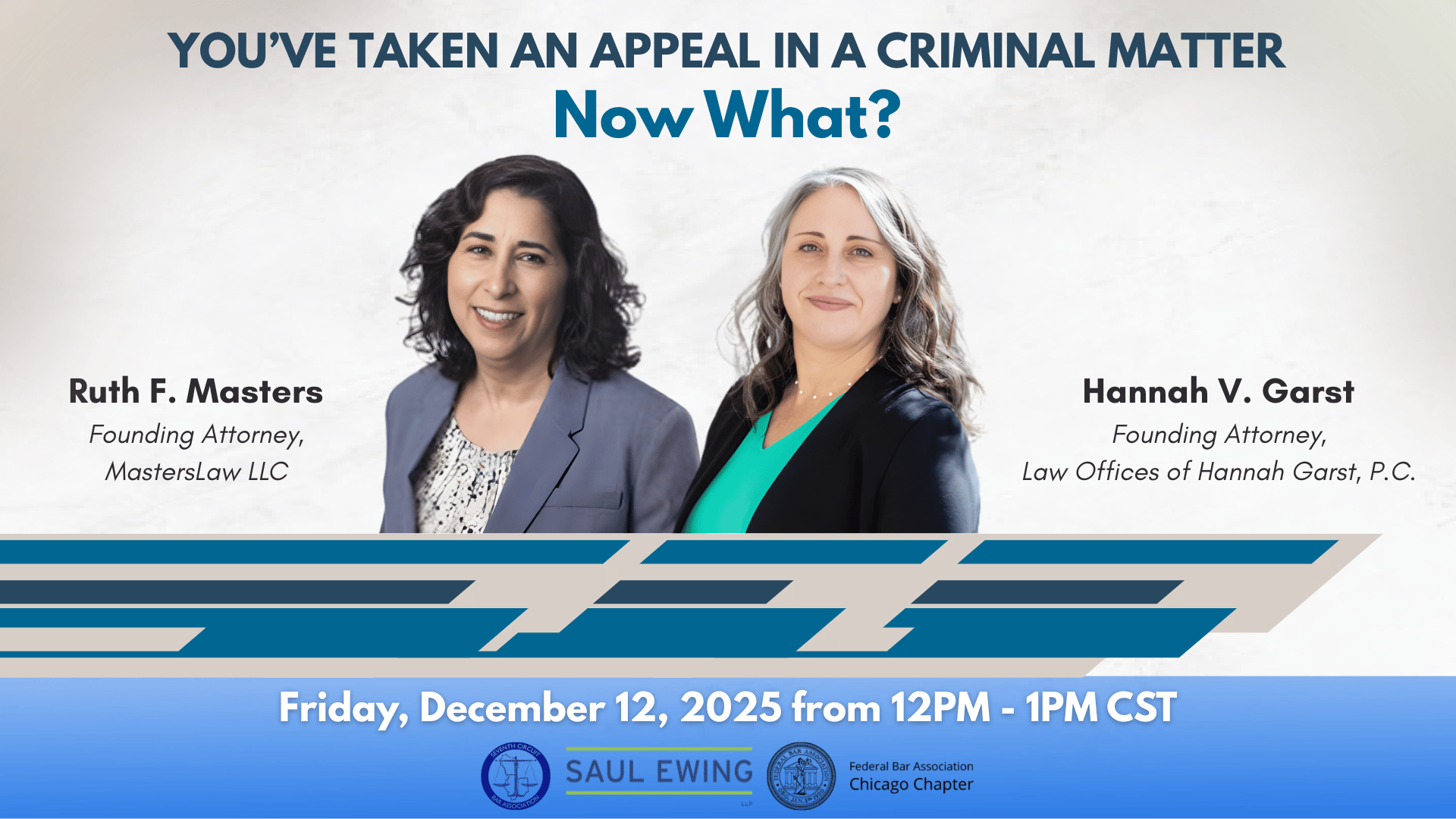
The Federal Bar Association Chicago Chapter, in collaboration with the Seventh Circuit Bar Association Criminal Law and Procedure Committee, invites members of the legal community to attend a one-hour continuing legal education (CLE) program: You’ve Taken an Appeal in a Criminal Matter, Now What? The event will take place via Zoom on Friday, December 12, 2025, from 12:00 p.m. to 1:00 p.m. CST.
This timely CLE offers practical insight into navigating the complexities of criminal appeals in federal court from the moment a notice of appeal is filed to final client communication at case conclusion. The program is structured as a step-by-step walkthrough of the appellate process, beginning with an overview of obligations to complete the record and maintain client communication, followed by a discussion of how to identify issues on appeal.
Attendees will then explore how the appellate focus shifts depending on whether the conviction resulted from a plea agreement or a trial, with presenters addressing key topics such as plea colloquies, appeal waivers, evidentiary rulings, and jury issues. The session will also cover sentencing review, including how to evaluate objections, guideline calculations, and statutory sentencing factors. The program concludes with practical guidance on brief preparation, client obligations, and post-analysis decisions, from determining when to file or withdraw an appeal to handling claims of ineffective assistance.
This virtual CLE program is free to attend, with administrative costs generously covered by Saul Ewing LLP. Participants will earn 1.0 hour of CLE credit (pending approval) in Illinois, Indiana, and Wisconsin.
To register, please email admin@7thcircuitbar.org to receive the Zoom access link and CLE materials.
December 12th Program Overview
The session will provide an overview of the federal criminal appeals process, identifying the steps needed to evaluate an appellate record and common issues to consider for appeal. Topics will include:
Preparing the Record: Key procedural obligations, issue spotting, and establishing lines of communication with clients.
Plea vs. Trial Appeals: How appellate focus shifts depending on whether the underlying conviction followed a plea agreement or a full jury trial.
Sentencing Review: Evaluating guideline calculations, objections, and the application of statutory sentencing factors.
Post-Analysis Steps: Determining when to file, withdraw, or advise dismissal of an appeal, and addressing client inquiries regarding ineffective assistance claims.
Attendees will gain practical frameworks for briefing decisions and for anticipating challenges unique to criminal appeals in the Seventh Circuit.
Featured Presenters for the December 12 Program
Hannah V. Garst, Founding Attorney, Law Offices of Hannah Garst, P.C.
Hannah Garst, a graduate of the University of North Carolina School of Law, began her career clerking for the Staff Attorney's Office at the Seventh Circuit Court of Appeals. During her time there, she worked on a diverse range of appeals, including criminal law, employment law, habeas corpus motions and petitions, immigration law, and social security law. After her clerkship, Hannah launched her own practice, focusing on criminal matters in both state and federal courts. She has been retained or appointed in over 150 federal criminal cases, and she has argued more than 20 cases before the Seventh Circuit Court of Appeals. Currently, she represents clients in both federal criminal and civil cases.
Ruth F. Masters, Founding Attorney, MastersLaw LLC
Ruth is an experienced appellate litigator with a record of obtaining precedential results on appeal, including reversing and defending multi-million-dollar judgments, obtaining acquittals, and vacating sentences. She has a deep knowledge of appellate practice. Her substantive practice areas include criminal law, labor and employment, civil rights, and personal injury. Prior to starting her own firm, she worked as an assistant corporation counsel for the City of Chicago Law Department and as an associate at Latham & Watkins. She clerked for Judge Charles Levin of the Michigan Supreme Court.